On a $20 community-concert ticket in 2026, Zeffy charges the organization nothing at all, and among the platforms that do charge, total fees run from about $1.72 to about $3.18. TicketSpice is the cheapest of those at roughly $1.72, EnsembleBase is next at about $1.91, and Eventbrite sits at the high end near $3.18. Zeffy is open to nonprofits only, and it funds itself by asking your ticket buyers for a contribution. Buyers can set that to zero, but the organization cannot remove the request from its own checkout, so read that row with the rest of its column.
That's the short answer. The longer answer is that fee structures are built differently (flat fees, percentages, per-order charges), so the ranking shifts with your ticket price and order size. Below is the math for each platform on a $20 ticket, a worked example for a full concert, and the two questions the fee table can't answer: when you get your money, and what happens on a refund. Every figure links to the platform's own published pricing, checked in July 2026; fee structures change, so confirm before you commit.
Disclosure. We make EnsembleBase, which is one of the six platforms in the tables below. Every competitor figure here comes from that company's own published pricing or help documentation as of July 2026, and each fee structure is spelled out below so you can redo the arithmetic yourself. Verify the current rates with any platform before you commit a season to it.
How each platform charges in 2026
Eventbrite charges a service fee of 3.7% + $1.79 per paid ticket, plus 2.9% payment processing per order. There is no cap on the per-ticket fee, so it scales with your ticket price without a ceiling.
TicketSpice charges $0.99 per ticket (49 cents for tickets under $5) plus card processing of 2.9% + $0.30 when the organizer absorbs the fees. Read the fine print if you plan to pass fees to buyers instead: TicketSpice's help center says that mode applies a flat 3.5% to the subtotal (the extra 0.6% replaces the $0.30 per transaction). On a $20 ticket that works out slightly cheaper than absorbing, which is the number we use below, and it is the reason TicketSpice comes out ahead of us.
TicketLeap charges $1.00 + 2% of the ticket price per ticket, plus a 3% online transaction fee per order. Ticketing fees stop at $20 per ticket, though that cap does not apply to the 3% transaction fee.
Brown Paper Tickets charges $1.49 + 6% per ticket, with payment processing included in that figure rather than added on top.
Zeffy charges the organization nothing: no platform fee, no per-ticket fee, and no card processing, which it absorbs. Two conditions come with that. It is open to nonprofits only, and its eligibility rules require an EIN and a bank account in the organization's name. And it funds itself at your checkout: every buyer is shown a voluntary contribution to Zeffy. Two separate things are worth keeping apart here. The amount is genuinely optional: Zeffy's own documentation describes a suggested rate that scales with the purchase, and buyers can adjust it down to zero. The request itself is not optional for you: the same documentation states the wording and suggested amounts cannot be customized, and there is no setting that removes the ask from your checkout. Every buyer you send there is solicited.
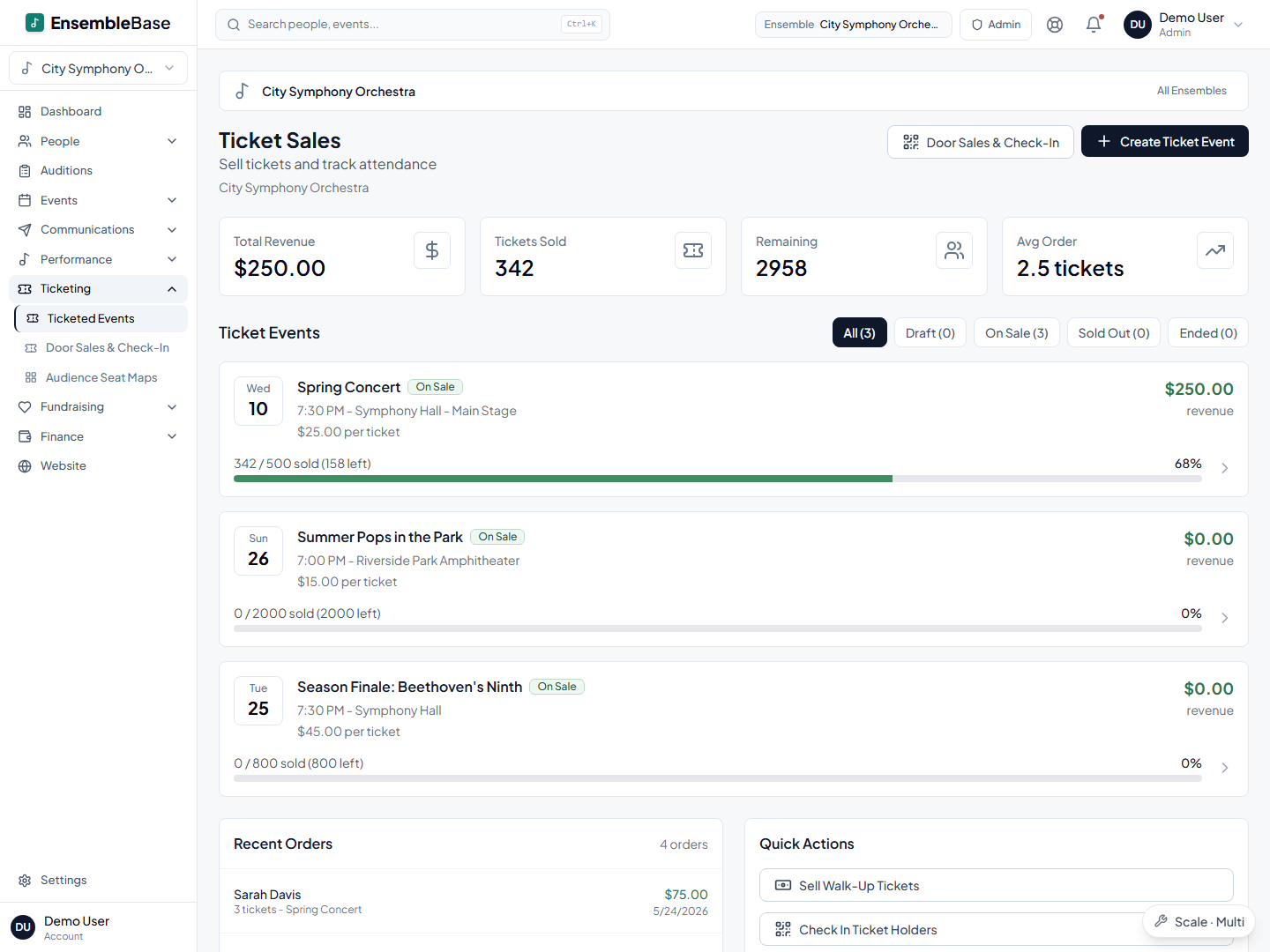
EnsembleBase charges a flat $1.00 service fee per paid ticket, plus standard Stripe card processing of 2.9% + $0.30. Both are presented to the buyer at checkout as boxes they can tick, and the service fee box is ticked for them. When buyers leave both covered (the totals in the tables below assume they do), your ensemble receives the full face value of the ticket. A buyer who unticks the service fee box still buys the ticket; the $1.00 comes out of your proceeds instead. Ticketing comes with the platform's Pro and Scale plans rather than as a separate product.
The fee table: a $20 ticket, platform by platform
| Platform | Service fee | Card processing | Approx. fees on $20 |
|---|---|---|---|
| Eventbrite | 3.7% + $1.79 per paid ticket (no fee cap) | 2.9% | ~$3.18 |
| Brown Paper Tickets | $1.49 + 6% per ticket | Included in service fee | ~$2.69 |
| TicketLeap | $1.00 + 2% per ticket (capped at $20/ticket) | 3% online transaction fee per order | ~$2.04 |
| EnsembleBase | $1.00 flat per paid ticket, buyer-covered by default | ~2.9% + $0.30 (Stripe) | ~$1.91 |
| TicketSpice | $0.99 per ticket (49¢ under $5) | 3.5% of the subtotal when fees are passed to buyers | ~$1.72 |
| ZeffyNonprofits only; EIN and an organizational bank account required | None charged to the organization. Your buyer is shown a contribution to Zeffy instead. | $0. Zeffy absorbs card processing. | $0 to your organizationEvery buyer is asked to add a contribution to Zeffy. They can decline; you cannot remove the request. |
Every rate above comes from the platform's own published pricing, checked in July 2026, so you can redo this yourself rather than take our word for it: Eventbrite, TicketSpice, TicketLeap, and Brown Paper Tickets. Pricing pages change without announcements, so confirm before you commit a season to anyone, us included.
Two caveats before you read too much into a single column. First, most of these platforms let the organizer choose whether to absorb fees or pass them to the buyer; the totals above are the same money either way, but who pays it changes your net, and on TicketSpice the choice also changes the processing rate itself. (On EnsembleBase the choice sits with the buyer rather than the organizer: the $1.00 service fee and card processing both appear as boxes at checkout, and the service fee box arrives ticked.) Second, percentage-based structures move with your price: Eventbrite and Brown Paper Tickets get relatively more expensive on a $35 ticket, while the flat structures stay put.
A worked example: 250 tickets at $20
Take a typical community concert: a 300-seat hall, tickets at $20, and about 250 sold. Face value is $5,000. Here is the approximate total in fees on those sales, assuming fees are passed to buyers where the platform allows it:
| Platform | Approx. fees per ticket | Approx. total fees (250 tickets) |
|---|---|---|
| Eventbrite | ~$3.18 | ~$795 |
| Brown Paper Tickets | ~$2.69 | ~$673 |
| TicketLeap | ~$2.04 | ~$510 |
| EnsembleBase | ~$1.91 | ~$478 |
| TicketSpice | ~$1.72 | ~$431 |
| ZeffyNonprofits only | $0 to you | $0 to youEach of your 250 buyers is asked to contribute to Zeffy. Each can decline; you cannot remove the request. |
The rule for reading this table: when buyers cover the fees, the ensemble receives the full $5,000; where a platform lets the organizer absorb them instead, the fee totals above come out of it. On EnsembleBase either fee reaches your payout only when a buyer unticks its box at checkout, and the service fee box starts ticked, so the common case is that your ensemble keeps the full $5,000.
Who the optional ask at your checkout is for
Fee tables miss something that matters to a small ensemble: several of these platforms put an extra request in front of your buyer at the moment of purchase, and the answer to "who receives it" varies. That checkout screen is the most valuable real estate you have with a patron. It is worth knowing who is using it.
On Zeffy the ask funds Zeffy. It appears on your event page, and while a buyer can decline it, the organization has no setting that removes it. Zeffy's own public feature-request board records nonprofits asking for the suggested amount to start at zero, with some reporting that their donors requested refunds after noticing the addition. Zeffy closed that request in March 2026 by adding a self-refund link and an "(optional)" label rather than changing the suggested amount. Those are their users' accounts on their own board, not our testing, and Zeffy's help center describes the contribution as never obligatory. Reasonable organizations land in different places on this. The money never comes out of your budget, and your supporters are the ones being asked.
On EnsembleBase the optional ask belongs to your ensemble. Our $1.00 service fee is a disclosed line item rather than a percentage of what your patron spends, and separately you can turn on a donation request at ticket checkout where you set the suggested amounts and every dollar goes to your organization. We take no percentage of it. The comparison we would rather be judged on is not whose fee is lowest but whose checkout is working for your ensemble.
When the money reaches your bank account
For a volunteer treasurer, payout timing matters more than the pennies separating the cheapest options. The deposits from your spring concert might be paying the hall rental for your fall one, and the platforms handle this very differently:
| Platform | When you get your money |
|---|---|
| Eventbrite | Paid out several business days after your event ends. |
| Brown Paper Tickets | Paid out after the event (see the note below on payout history). |
| TicketLeap | Held until 4–7 days after the event; faster payout requires approval for their FastPay program. |
| TicketSpice | Weekly payouts by default, including the week of your event. |
| EnsembleBase | Sales land in your organization’s own Stripe account as they happen — you are the merchant of record. Stripe pays out on its standard rolling schedule, and you can watch the balance in EnsembleBase. |
Being the merchant of record cuts both ways, and you should know that going in: card disputes land on your organization's Stripe account rather than a platform's, and a brand-new Stripe account has onboarding (bank details, identity verification) plus a slower first payout before the rolling schedule kicks in.
Refunds deserve the same scrutiny. Your refund policy is yours to set on every platform; the question is who keeps the fees when you issue one. Eventbrite keeps its service and processing fees on refunded tickets (fee credits exist for full cancellations, by request). On EnsembleBase, refunds come out of your own Stripe balance: you record the refund in the app, which releases the seats and invalidates the tickets, and complete the payment in your Stripe dashboard. Stripe keeps its processing fee, and the $1.00 service fee stays with EnsembleBase on refunds you issue. TicketSpice, TicketLeap, and Brown Paper Tickets publish less about refund fee handling; ask directly before you commit. Whatever platform you choose, run one imaginary snowed-out concert through its refund policy before you sign up.
One piece of history worth knowing: in September 2020, the Washington State Attorney General sued Brown Paper Tickets after 583 complaints, alleging the company owed roughly $6 million to event organizers whose events had already happened, plus $760,000 in refunds to ticket buyers. The lesson applies to every platform on this list: before you sell a season through anyone, search the platform's name plus "payout problems" and read what organizers say. Fee tables are public; payout reliability you have to go looking for.
The trade-off: platform plan vs. standalone processor
Here is the part we have an interest in blurring, so we'll put a number on it instead. TicketSpice beats EnsembleBase on per-ticket fees by about 19 cents on a $20 ticket, or roughly $48 across a sold-out 250-seat concert. The structural difference matters more than the 19 cents: TicketSpice, Eventbrite, TicketLeap, and Brown Paper Tickets charge no subscription at all, while ticketing here is part of a paid EnsembleBase plan.
So do this arithmetic before you choose us. Take the annual cost of the plan you would need, divide it by the tickets you actually expect to sell in a year, and add that to our $1.00. If ticketing is the only thing you want, that number will land above the platforms with no subscription, and it will not be close, because a 19-cent-per-ticket edge takes thousands of tickets to repay any annual fee. Choose EnsembleBase for ticketing alone and you are overpaying. The case only works the other way around: if you also need the roster, availability polling, dues, email, and event pages, the plan buys all of that and the box office comes with it, and the comparison stops being about 19 cents. Current plan pricing is on our plans page.
What the per-ticket fee doesn't show:
- The fee is flat and predictable: $1.00 per paid ticket whether you charge $10 or $40, with no percentage of your price and no fee-cap fine print.
- Ticket money goes to your organization’s own Stripe account, not a platform balance you wait on.
- Online buyer lists land next to your donor and member records — the names you’ll ask for a donation in the fall.
What changes the math
- Order size. Per-order components (TicketLeap’s 3% online transaction fee, Stripe’s $0.30 per charge) spread across multi-ticket orders, so a family of four costs slightly less per ticket than four separate buyers.
- Ticket price. Rerun the math at your price point before choosing — the percentage-heavy structures pull further ahead of the flat ones as prices rise.
- Time. Fee structures change, and platforms rarely announce it loudly, so treat every figure here as a July 2026 snapshot and re-check the pricing page before you sign up.
One roster powers everything
In EnsembleBase, your member list is entered once and reused everywhere. Every tool below works from the same roster — no re-typing names, no out-of-sync copies.
Frequently asked questions
Is a zero-fee platform like Zeffy the cheapest option?
For a registered nonprofit selling general admission tickets, Zeffy costs the organization nothing, covers card processing, and includes e-tickets and QR check-in, so on price it wins outright. Two things to weigh before you decide. It requires nonprofit status, an EIN, and an organizational bank account, so informal ensembles are not eligible. And it funds itself with a contribution request shown to your buyers at your checkout. Buyers can decline it, but you cannot remove it: the fee you avoid is put to your supporters instead, on a page carrying your name. Some boards consider that a fair trade and others do not.
Who pays ticketing fees — the buyer or the ensemble?
It depends on the platform and your settings. Most platforms let organizers either absorb fees (deducted from your payout) or pass them to buyers at checkout. On EnsembleBase the buyer decides: the flat $1.00 service fee and the card processing cost each appear as a box at checkout, and the service fee box is ticked by default. With both covered, your ensemble receives the ticket’s face value. When a buyer unticks the service fee, that $1.00 comes out of your proceeds rather than being waived.
Can we avoid card processing fees entirely?
Not for online card sales. Processing fees around 2.9% + $0.30 are what card networks and processors like Stripe charge, and every platform passes them through in some form. The only sales that avoid them are cash transactions at the door, which come with their own counting and reconciliation work.
Do these fees apply to free tickets?
Service fees on the platforms compared here apply to paid tickets. Free and comp tickets generally do not incur service fees, on EnsembleBase or the others, though policies vary in the details — verify with any platform you are considering before publishing a free event.
Do ticketing platforms offer nonprofit discounts?
Some platforms offer reduced rates for registered nonprofits, usually on request rather than automatically. The figures in this article are standard published 2026 rates. If your ensemble is a 501(c)(3), ask each platform directly, and check whether any discount covers the service fee, the processing fee, or both.
Keep reading
Ticketing & box office
Concert ticketing software that never takes a percentage of the ticket price
Read the guideTicketing & box office
How to sell tickets for a community concert
Read the guideMoney & fundraising
How to collect member dues without the awkwardness
Read the guideOperations
Planning a concert season: the master timeline and checklist
Read the guideThe bottom line
Flat fees, full face value, your own Stripe account.
EnsembleBase charges a flat $1.00 per paid ticket plus standard card processing, with buyers covering fees at checkout — and every sale lands in your organization's own Stripe account, in the same platform as your roster, email, and dues.
Request Early Access